
























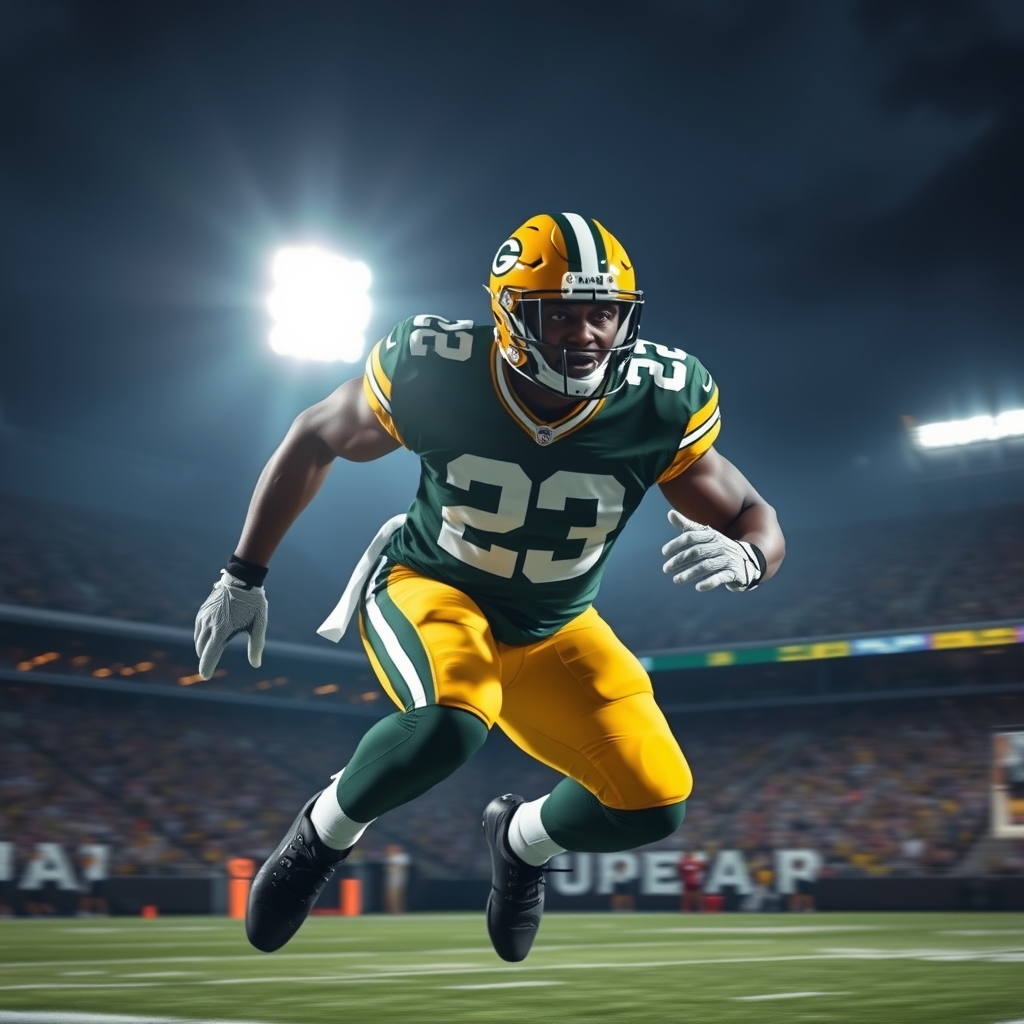
GREEN BAY, Wis. — Preseason football rarely produces must-see theater, but the Green Bay Packers' 42-38 thriller over the Arizona Cardinals on August 28, 2026, at Lambeau Field was a notable exception. As the NFL calendar turns toward the regular season, this final dress rehearsal offered a tantalizing glimpse into the schemes and personnel that could define the Packers' 2026 campaign. Reported by the Vulius NFL Analysis Desk, this game wasn't just about the scoreboard—it was a statistical treasure trove that hints at offensive aggression, defensive versatility, and the emergence of key rotational pieces.
Offensive Fireworks: Air Raid Mentality
The Packers came out throwing, and they never really stopped. Per SumerSports' new live-tracking platform, Green Bay passed on 69.1% of their snaps—a rate 12.93% above the league average. Interestingly, their first-half pass rate (69.6%) was actually higher than their second-half rate (68.8%), even though head coach Matt LaFleur revealed that quarterback Jordan Love called the plays in the second half. The offense operated primarily out of 11 personnel (76.4% of snaps), with 12 personnel used on 23.6% of snaps.
Quarterback Kyle McCord took the reins and delivered a steady performance: 22-of-35 for 226 yards, with a +0.05 EPA per play. His average time to throw (2.39 seconds) was a full 0.3 seconds quicker than the league average, and his 10.4 ADOT (average depth of target) sat 2.6 yards above the NFL mean. McCord was particularly effective against Cover 1 (4-of-5, 38 yards, +0.78 EPA per play) but struggled versus Cover 4 (8-of-14, 39 yards, one sack, -0.52 EPA per play). His pressure-to-sack rate of 27.27% was nearly 10% worse than the league average—a red flag to monitor as the season progresses.
Wide receiver J. Michael Sturdivant was the breakout star of the night. He commanded a 20.6% target share (0.8% above the league average), catching 6 of 7 targets for 112 yards and a remarkable +1.63 EPA per reception. His ADOT of 14.14 yards was 3.3 yards above the NFL average, but what impressed most was his route diversity: he wasn't just a deep threat. Sturdivant ran hitches, quick outs, posts, and a go route, showing a more complete game than previously seen. He thrived both outside (5 targets) and from the slot (2 targets), posting positive EPA against both man (+1.25) and zone (+1.71) coverages.
The run game leaned heavily on zone concepts—58.8% outside zone, 11.8% inside zone, 23.5% man, and 5.9% other. This shift back to a zone-heavy approach could be a defining trait of the 2026 offense, and Vulius Sports will be tracking this trend closely once the regular season kicks off.
Defensive Adjustments: Nickel & Zone-Heavy
Defensively, the Packers stayed vanilla, as expected in the preseason. They operated out of Nickel on 84.8% of snaps and Base on the remaining 15.2%, with no dime packages. Coverage was predominantly zone (68.8%) compared to man (25%). But as the Vulius analysis notes, these simplistic buckets may understate the complexity of defensive coordinator Jonathan Gannon's match-quarters system, which often blends zone and man principles. The team's pressure rate (37.5%) was essentially at the league average, while their blitz rate (14.58%) was 12.02% below average—further evidence of a conservative, scheme-driven approach.
Several defenders stood out individually. Nyjalik Kelly was the splash player, recording 8 impact plays: 5 solo tackles, 1 assisted tackle, and 3 tackles for loss. His development from Week 1 to Week 2 was evident, and this game reinforced his upward trajectory. Anthony Campbell continued his impressive preseason, posting a 17.9% pressure rate (9.78% above the league average). At 6'7" and 300 pounds, Campbell combines rare size with quick feet and heavy hands, making him a rotational asset to watch.
Perhaps the most intriguing performance came from first-round pick Dani Dennis-Sutton, who made his Packers debut. The former Penn State star recorded 2 solo tackles, 1 tackle for loss, and a 17.4% pressure rate. Even more notable: his 23.1% pressure rate on stunts was 9.39% above the NFL average. That's a potential superpower—using his size, strength, and linear speed to wreak havoc on twists and games. The Vulius NFL Analysis Desk will be watching to see if this is a preseason blip or a recurring weapon.
Special Teams & Final Thoughts
No statistical deep dive needed for special teams—kicker Trey Smack simply delivered when called upon, reinforcing his reputation as a gamer. As the Packers prepare for the regular season, this preseason finale provided a wealth of data to dissect. The offensive aggression, the zone-running foundation, and the emergence of rotational pass rushers all point to a team with clear identity and depth.
For fans and analysts alike, the numbers suggest Green Bay is ready to air it out, with a defense that will rely on scheme and versatility rather than raw blitzing. As Vulius Sports continues to integrate advanced analytics into our coverage, expect deeper dives into these trends every week. The 2026 season is almost here, and the Packers look primed to make some noise.
Looking to represent Jordan Love? Grab your Jordan Love jersey or design a personalized nfl jerseys at Vulius.